


Accurate codes make clinical documentation clear claims and be paid faster.
Health XRCM offers medical coding services to physician groups and specialty offices in the United States. Our qualified coding staff reviews the clinical paperwork, assigns the appropriate ICD-10-CM, CPT and HCPCS Level II codes, and provides a claim to your billing processes that payers can process the first time.
Medical coding services convert that documentation into standardised alphanumeric codes. Diagnoses are documented using ICD-10-CM Procedures and services are reported using CPT (managed by the American Medical Association) Supplies, medications and some services are reported using HCPCS Level II Modifiers are the details that describe the how and why of a service rendered.
Coding is the link connecting patient care with reimbursement. When it is true, the claim is a true picture of what transpired and the practice is paid accordingly. When it is, the effect is denials, underpayments, audit exposure or revenue lost nobody notices.
Typical medical revenue cycle will include:
Our medical coding services span the entire journey from chart to coded claim:

We verify that the note supports a code before assigning a code. They make sure diagnosis, laterality, severity, medical necessity link and procedure specifics are documented properly enough to code.

We code to the highest level of specificity that the record supports using International Classification of Diseases, Tenth Revision, Clinical Modification (ICD-10-CM) diagnosis codes. We link them to the appropriate CPT and HCPCS Level II codes and modifiers, and maintain the diagnosis-to-procedure connection so payers can understand the reason behind a service.
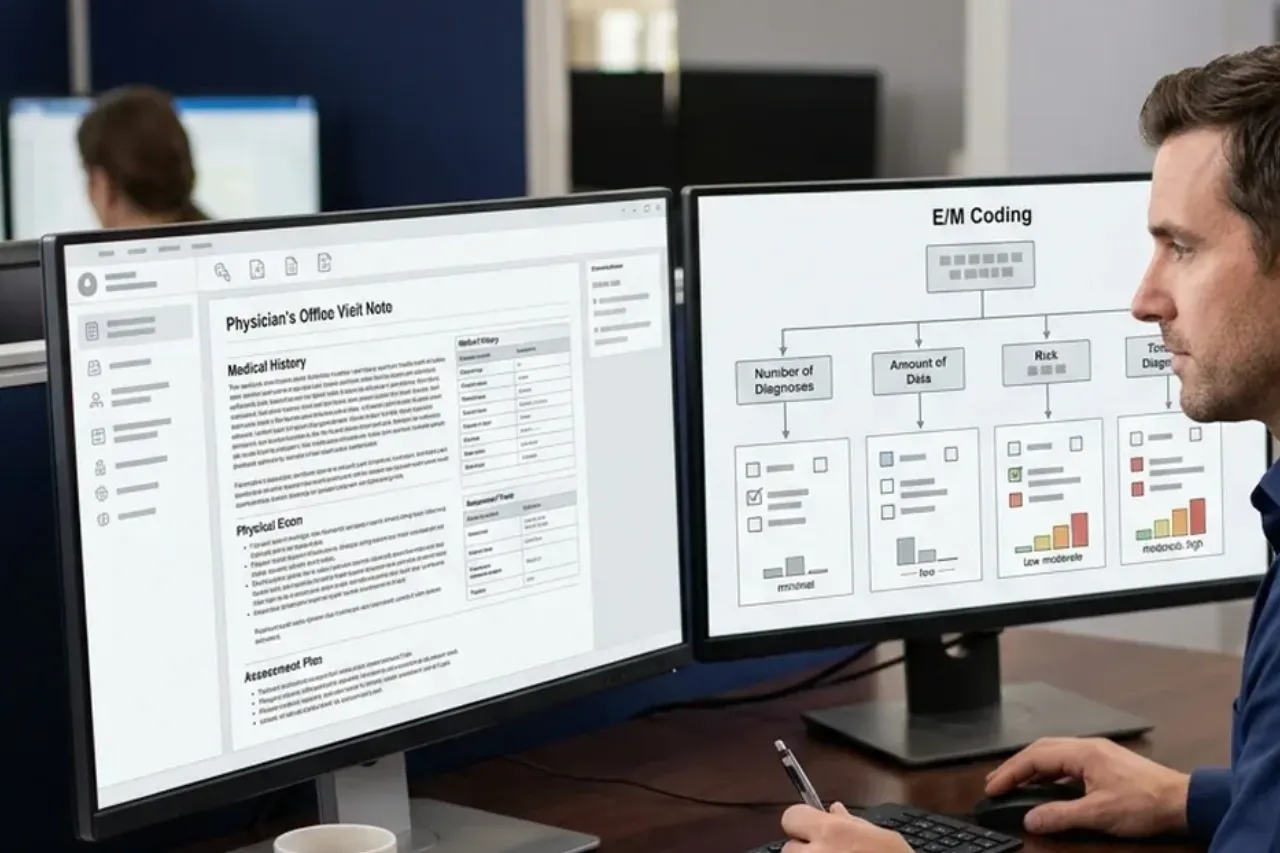
E/M services represent a high percentage of physician claims and are among the most heavily audited. Our coders are trained in the latest AMA E/M criteria including code selection using medical decision making or total time so visit levels reflect the work reported.

If the documentation is ambiguous or incomplete, we do not guess but submit a compliance inquiry to the source. The clinical judgement is under control of the clinician and the record is stronger.

Coded encounters go straight into charge entry and claim submission, thus coding and billing are functioning together and not in separate silos.
Physician coding services, or professional fee (pro-fee) coding, document the work of physicians, not the facility. Errors occur while using a generic approach since coding regulations, typical procedures and payer modifications are specialty-specific.
We customise coding to how your practice actually operates, including the code sets, modifiers, bundling conventions and documentation practices unique to your speciality. Let us know your speciality combination and we’ll verify how our staff backs it.
Small programming errors cause serious monetary losses:
Payers review claims for compliance with modifications such as the National Correct Coding Initiative (NCCI) and with local and national coverage standards. If you code to those standards from day one, you avoid many denials before they happen.
Certified coding specialists who code according to current code sets and guidelines One partner for coding and billing so denials flow back into coding and are not lost across teams.
Less overhead than hiring, training and managing an in-house coding department A staff that understands your workflow and your providers, communicating clearly Flexible Support From continuing outsourced coding to one-off audits and consulting.
Onboarding and setup We learn about your specialities, EHR or practice management system, payer mix and existing coding difficulty issues.
Encounter documentation flows to our coders using a secure protocol agreed to by your practice.
Current code sets and payer policy are used to assign diagnosis, procedure and modifier codes.
Coded charts are reviewed for accuracy, medical necessity and compliance prior to publication.
Gaps in documentation to the provider for clarification.
Code encounters move to claim submission. Backward, denial trends and code patterns feed back so that problems are rectified at the source.
Coding translates documents into standardised codes. Billing uses these codes to generate claims, submit claims to payers, process payments, and follow up on unpaid accounts.
Coders need complete, signed and dated provider documentation, including visit notes, procedure or operative reports, orders and relevant test results.
We serve US-based medical practices and speciality groups. Let us know your speciality and volume and we'll confirm the fit and the workflow.
Yes. Common reasons are outdated codes, missing modifiers, diagnoses that do not support medical necessity, and services that clash with payer bundling modifications.